Song of Solomon by Toni Morrison
Publisher: Vintage
Publication Year: 1977
Buy: Song of Solomon at Amazon
Rating: 
Table of Contents
Introduction
Have you ever felt like a stranger in your own life? Like something essential is missing, but you can’t name what it is?
That’s Milkman Dead at the start of Song of Solomon. Born into wealth but spiritually bankrupt, he drifts through life numb and selfish, treating the people who love him like props in his personal drama. He doesn’t know his family’s real name. He doesn’t know where he comes from. He doesn’t know who he is.
Then he goes searching for gold and finds something far more valuable: the truth about his ancestors, hidden not in documents or libraries, but in children’s songs, old stories, and the memories of people who remember. What he discovers changes everything; about his family, about freedom, about what it means to truly fly.
This is a novel about the weight we carry and the things that set us free. It’s about names that bear witness, women who endure, men who abandon, and the price of flying away. Most of all, it’s about a young man learning the hardest lesson: you can’t become yourself by running from where you came from. You have to go back to move forward.
Morrison wrote this in 1977, but the questions it asks feel urgent today: Who are you when you don’t know your history? What do you owe the people who loved you? Can you be free without being alone?
The Book in 3 Sentences
Song of Solomon follows Macon “Milkman” Dead III, an alienated young Black man from a wealthy but dysfunctional Michigan family in the 1960s, who sets off on a journey south chasing rumors of hidden gold. Instead, he discovers something far more valuable: his true identity and ancestral story, preserved in oral tradition, folklore, and community memory. By the time he returns, he’s no longer running away; he’s finally learned how to fly.
Key Characters
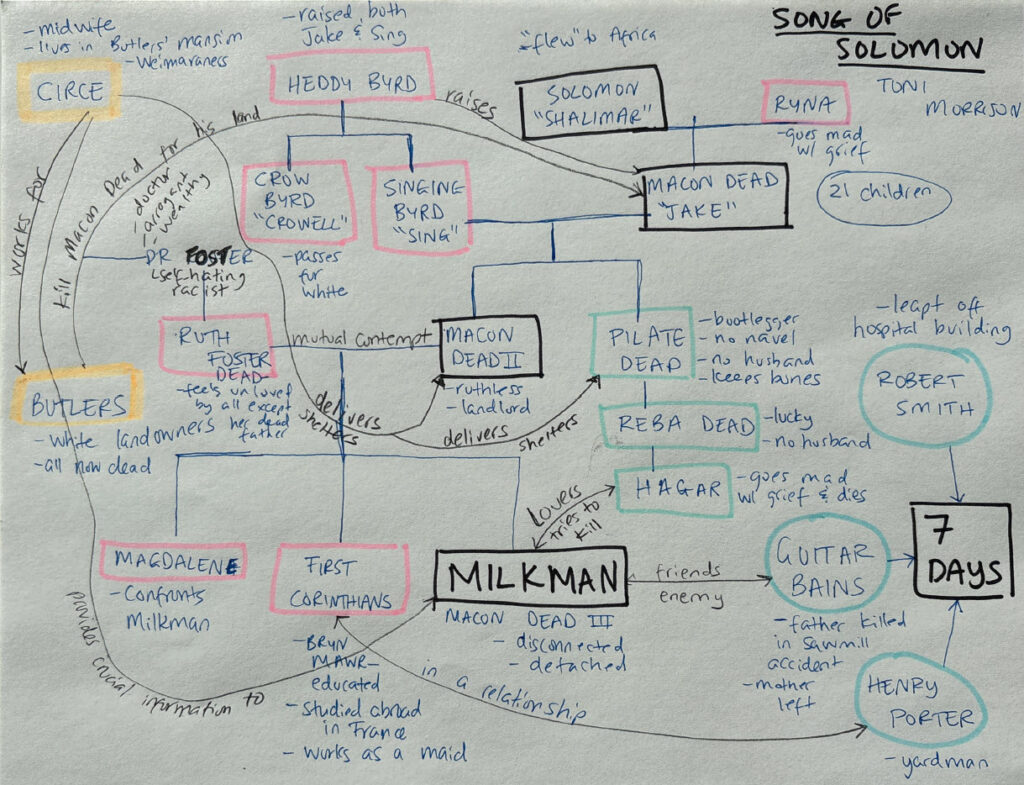
1. Macon Dead III and His Immediate Family
Macon ‘Milkman’ Dead III
Our protagonist. Nicknamed “Milkman” because his lonely mother nursed him way beyond infancy. Born into wealth but spiritually empty. Spends thirty-one years emotionally detached, using people, avoiding commitment. His journey south transforms him from a taker into someone capable of love and responsibility.
Macon Dead II (Milkman’s father)
A ruthless landlord who worships money, property and status. Believes “money is freedom” but lives spiritually dead. Treats his wife Ruth with open contempt, sometimes violently. Fears and hates his sister Pilate, viewing her unconventional lifestyle as an embarrassment. His obsession with the “stolen” gold poisons him for fifty years.
Ruth Foster Dead (Milkman’s mother)
Daughter of the first Black doctor in the city. Lives under her husband’s daily contempt, clinging to the memory of her dead father with near-obsessive devotion. She relied on Pilate’s magic to conceive Milkman and fought to keep him alive against her husband’s wishes.
Magdalene “Lena” Dead (Milkman’s older sister)
Finally confronts Milkman about his selfishness in the novel’s most devastating speech. Accuses him of acting exactly like their father—judging, using, deriving privilege from his gender while contributing nothing.
First Corinthians Dead (Milkman’s older sister)
Educated at Bryn Mawr, studied in France. Works secretly as a maid (calling herself an “amanuensis”) to escape the suffocation. Falls in love with Henry Porter, one of her father’s tenants; a relationship Milkman disrupts by telling their father. Later moves in with Porter.
2. Pilate’s Household
Pilate Dead
The moral center of the novel. Macon II’s sister, born without a navel—a “defect” that forces her into radical self-creation. A self-reliant bootlegger who talks to her dead father’s ghost, indifferent to money and societal norms. She saved Milkman’s life twice (helping Ruth conceive him, protecting her during pregnancy). Carries what everyone thinks is gold in a green sack for decades; but it’s actually her father’s bones.
Reba (Pilate’s daughter)
Milkman’s cousin. Unnaturally lucky at winning things, which she gives away to undeserving men. Simple, kind, devoted to her daughter Hagar.
Hagar (Pilate’s granddaughter)
Milkman’s second cousin and former lover. After he ends their relationship with a cold breakup note and some cash, she tries to kill him once a month. Eventually dies consumed by grief and the obsessive belief that if she could just make herself beautiful enough, he’d love her again.
3. The Ancestors
Jake (Macon Dead I)
Milkman’s grandfather. The youngest of Solomon’s twenty-one children, raised by Heddy after Solomon flew away. Married Sing and fathered Macon II and Pilate. Built a prosperous farm called “Lincoln’s Heaven” in Pennsylvania, until white landowners (the Butlers) murdered him for it. His body was dumped in a cave. Pilate carried his bones in that green sack for decades, not knowing they were his.
Solomon (Shalimar)
Milkman’s great-grandfather. The “Flying African” who escaped slavery by literally flying away, abandoning his wife Ryna and twenty-one children. The town of Shalimar, Virginia is named after him.
Ryna
Solomon’s wife. Went insane from grief after he flew away, crying for days. The nearby ravine (Ryna’s Gulch) is named for the continued echoes of her sorrow.
Sing (Singing Bird)
Milkman’s grandmother. Part Native American, daughter of Heddy. Married Jake. Died giving birth to Pilate.
Heddy
Mother of Sing. An Indian woman who found Jake after Solomon left and raised him.
Circe
Ancient midwife who delivered both Macon II and Pilate, and sheltered them after their father’s murder. Lives in the decaying Butler mansion (their father’s killers), tending to the Butlers’ Weimaraner dogs, and deliberately letting the mansion rot as revenge. Reveals the family’s true names to Milkman decades later.
4. External Relationships
Guitar Bains
Milkman’s best friend turned would-be killer. Member of the Seven Days, a secret society that murders white people to “balance” unpunished racist killings. He’s the “Sunday man.” Eventually tries to kill Milkman over the gold. Kills Pilate.
Henry Porter
Macon Dead II’s tenant; and the older lover of Corinthians Dead. He eventually moves in with Corinthians to a small house in Southside. He is a member of the Seven Days.
Sweet
A woman in Shalimar who cares for Milkman after he’s injured. Teaches him reciprocity—how to give as well as take. Their mutual care for each other is the first truly balanced relationship Milkman has ever had.
Freddie
A janitor, as well as Macon II’s flunky. Freddie is the town gossip. Freddie spreads rumors through the town, an avatar of the importance of oral tradition in African American communities. Freddie coins the nickname “Milkman” for Ruth’s son when he witnesses her nursing him way beyond infancy. The nickname sticks permanently, showing how original names can be erased and forgotten.
Robert Smith
A North Carolina Mutual Life Insurance agent who jumps off the roof of Mercy Hospital in the first chapter. His death precedes Milkman’s birth. A member of the Seven Days.
The Butlers
The Butlers are a wealthy white family from Danville, Pennsylvania. They murdered Milkman’s grandfather, Macon Dead I (Jake), because they wanted his farmland for themselves. According to Reverend Cooper, the Butlers are all dead. The last one, Elizabeth Butler, killed herself a couple of years prior to Milkman’s visit.
Key Locations
The North (Michigan)
Not Doctor Street
The Dead family’s neighborhood. Called “Doctor Street” by Black residents honoring Ruth’s father (the first Black doctor in town), but officially renamed by the city as Mains Avenue. The community’s stubborn response: “Not Doctor Street.” This defiant renaming captures the whole novel: official history versus living memory.
Southside/The Blood Bank
The working-class Black neighborhood where Pilate runs her wine house on Darling Street with Reba and Hagar, and where Milkman spends time while running errands for his father. Where Guitar and the Seven Days meet.
The South
Montour County, Pennsylvania (Lincoln’s Heaven)
The Dead family farm where Jake built a life before the Butlers murdered him for it. Macon II and Pilate grew up here. The farm contained a valley, Montour Ridge, a pond, and fruit trees. Now it is just ruins.
Danville, Pennsylvania
Where Circe lives in the rotting Butler mansion, deliberately letting their legacy decay. Where Milkman learns his grandfather’s real name was Jake and hears the story of his murder. Milkman also gathers key history at Reverend Cooper’s house.
The Hunter’s Cave
Located near the Butlers’ house in Danville. Where young Macon II and Pilate found the gold after their father died. Where Macon II killed an old white man. Where Jake’s body was eventually dumped after floating up from its shallow grave.
Shalimar, Virginia
The end of the road. A tiny Blue Ridge Mountain hamlet named after Solomon himself (the locals pronounce it “Shalleemone”). Here Milkman hears children singing his family history, stays with Sweet, and finally understands everything.
Solomon’s Leap
The double-headed rock overlooking the valley where Solomon flew away. Where Milkman and Guitar have their final confrontation. Where Pilate dies after finally bringing her father’s bones home.
Ryna’s Gulch
The ravine that still echoes with Ryna’s grief. A permanent scar in the landscape, like the trauma itself.
Major Themes
1. The Quest for Identity, Heritage, and Naming
Milkman starts the novel spiritually “dead”—rootless, alienated, materialistic. His identity crisis isn’t philosophical; it’s existential. He literally doesn’t know his name.
The family name “Dead” came from a drunk Union soldier’s error at the Freedmen’s Bureau, after the Civil War. He wrote down “Macon” (birthplace) and “dead” (father’s status) as Jake’s name.
Morrison writes that “Dead” was a “heavy name scrawled in perfect thoughtlessness (p.25)”, erasing their real history. But Jake’s wife Sing kept the name, thinking it was “new and would wipe out the past.(p.59)”
Names in this novel aren’t just labels; they’re containers of history, trauma, and identity. Late in his journey, Milkman reflects on the names he’s encountered:
He closed his eyes and thought of the black men in Shalimar, Roanoke, Petersburg, Newport News, Danville, in the Blood Bank, on Darling Street, in the pool halls, the barbershops. Their names. Names they got from yearnings, gestures, flaws, events, mistakes, weaknesses. Names that bore witness. Macon Dead, Sing Byrd, Crowell Byrd, Pilate, Reba, Hagar, Magdalene, First Corinthians, Milkman, Guitar, Railroad Tommy, Hospital Tommy, Empire State (he just stood around and swayed), Small Boy, Sweet, Circe, Moon, Nero, Humpty-Dumpty, Blue Boy, Scandinavia, Quack-Quack, Jericho, Spoonbread, Ice Man, Dough Belly, Rocky River, Gray Eye, Cock-a-Doodle-Doo, Cool Breeze, Muddy Waters, Pinetop, Jelly Roll, Fats, Lead-belly, Bo Diddley, Cat-Iron, Peg-Leg, Son, Shortstuff, Smoky Babe, Funny Papa, Bukka, Pink, Bull Moose, B.B., T-Bone, Black Ace, Lemon, Washboard, Gatemouth, Cleanhead, Tampa Red, Juke Boy, Shine, Staggerlee, Jim the Devil, Fuck-Up, and Dat Nigger. (p.324)
His breakthrough comes when he decodes a children’s song in Shalimar. Hidden in playground nonsense is his entire family tree: Solomon flew away. Ryna went mad. Jake was the last of Solomon and Ryna’s twenty-one children. Heddy (his great-great-grandmother) was Native American. Names bear witness to history.
This knowledge transforms him. It gives him roots—to himself, to the earth, to his ancestors. The disconnection falls away. He’s no longer floating. He finally has gravity.
2. Flight: Freedom vs Abandonment
The novel asks: What does it mean to fly? Flight symbolizes both liberation and desertion.
The narrative begins with Robert Smith attempting to fly from the roof of Mercy Hospital (a literal attempt at escape via suicide).
Solomon flew to freedom but abandoned his wife and twenty-one children. Macon II thinks money is freedom but lives spiritually imprisoned. Milkman wants to escape through “boats, cars, airplanes.(p. 180)”
The white peacock can’t fly because its fancy tail weighs it down:
“Too much tail. All that jewelry weighs it down. Like vanity. Can’t nobody fly with all that shit. Wanna fly, you got to give up the shit that weighs you down” (p.180).”
Materialism weighs it down. True liberation, ie., physical or spiritual flight, requires sacrificing material wealth (the “jewelry”) and emotional burdens, especially selfishness and greed.
But Pilate shows another way: she flies “without ever leaving the ground (p.331)” through love, responsibility, and spiritual freedom. She is self-sufficient, free of societal constraints, and achieves a spiritual “soaring” without abandoning those she loves.
Even dying, she points towards connection, saying “I wish I’d a knowed more people. I would of loved ’em all. If I’d a knowed more, I would a loved more. (p.331)”
Milkman’s final leap happens only after he abandons the pursuit of gold and embraces responsibility. True freedom (flight) is possible only after abandoning self-interest and embracing love and destiny.
True freedom requires surrender: “For now he knew what Shalimar knew: If you surrendered to the air, you could ride it.(p.331)”
3. Responsibility Over Selfishness
Milkman spends most of his life taking. Morrison describes his philosophy:
“He avoided commitment and strong feelings, and shied away from decisions. He wanted to know as little as possible, to feel only enough to get through the day amiably and to be interesting enough to warrant the curiosity of other people—but not their all-consuming devotion (p.181)”
He uses his cousin Hagar for years, then ends it with a breakup note and cash. He reflects:
She [Hagar] was the third beer. Not the first one, which the throat receives with almost tearful gratitude; nor the second, that confirms and extends the pleasure of the first. But the third, the one you drink because it’s there, because it can’t hurt, and because what difference does it make? (p.95)
His sister Lena finally confronts him about his selfishness and entitlement:
You’ve been laughing at us all your life. Corinthians. Mama. Me. Using us, ordering us, and judging us: how we cook your food; how we keep your house. But now, all of a sudden, you have Corinthians’ welfare at heart and break her up from a man you don’t approve of. Who are you to approve or disapprove anybody or anything? I was breathing air in the world thirteen years before your lungs were even formed. Corinthians, twelve. You don’t know a single thing about either one of us—we made roses; that’s all you knew—but now you know what’s best for the very woman who wiped the dribble from your chin because you were too young to know how to spit. Our girlhood was spent like a found nickel on you. When you slept, we were quiet; when you were hungry, we cooked; when you wanted to play, we entertained you; and when you got grown enough to know the difference between a woman and a two-toned Ford, everything in this house stopped for you. You have yet to wash your own underwear, spread a bed, wipe the ring from your tub, or move a fleck of your dirt from one place to another. And to this day, you have never asked one of us if we were tired, or sad, or wanted a cup of coffee. You’ve never picked up anything heavier than your own feet, or solved a problem harder than fourth-grade arithmetic. Where do you get the right to decide our lives?… I’ll tell you where. From that hog’s gut that hangs down between your legs. . . . I didn’t go to college because of him. Because I was afraid of what he might do to Mama. You think because you hit him once that we all believe you were protecting her. Taking her side. It’s a lie. You were taking over, letting us know you had the right to tell her and all of us what to do. . . . I don’t make roses anymore, and you have pissed your last in this house.(p.215)
His journey south strips away his privilege. It teaches him gratitude and the importance of self-reliance.
He learns that only his mother and aunt Pilate “fought for his life, and he had never so much as made either of them a cup of tea. (p.325)”
He realizes the only things that matter are what you’re “born with, or had learned to use. And endurance.” (p.275)
The word “deserve” starts to sound “old and tired and beaten to death. (p.275)” Milkman understands:
“Apparently he thought he deserved only to be loved—from a distance, though—and given what he wanted. And in return he would be… what? Pleasant? (p.275)”
Milkman finally understands what his grandfather’s ghost meant: “You just can’t fly on off and leave a body.(p.150)” You can’t become free by abandoning people who love you. By abandoning Hagar and pursuing selfish flight, Milkman was repeating Solomon’s mistake.
Milkman’s final act of responsibility: ensuring his grandfather Jake is properly buried. The bones Pilate carried weren’t the prospector’s; they were her father’s. Helping her fulfill this duty frees Milkman to achieve true flight.
4. Women Bear the Weight
The men fly away. The women stay and endure.
Ruth endures her husband’s daily contempt. Daughters Lena and Corinthians waste their potential and education making fake roses. Hagar descends into madness and dies. Ryna lost her mind when Solomon left her with twenty-one kids.
These are abandoned women. They suffer intense psychological damage from the selfishness and absence of men.
But Pilate—born without a navel, rejected by society—becomes the freest person in the novel. Her “defect” forces radical self-creation. People felt “terror of having been in the company of something God never made,(p.146)” so she had to abandon all assumptions and build herself from zero:
Then she tackled the problem of trying to decide how she wanted to live and what was valuable to her. When am I happy and when am I sad and what is the difference? What do I need to know to stay alive? What is true in the world? (p.151)
She cuts her hair, refuses to rely on men, becomes a bootlegger. Her lack of a navel symbolizes her independence from conventional origin stories. Pilate embodies radical autonomy, self-reliance, and unconditional love.
Women hold the world together while men chase freedom. But Pilate proves you can be free without abandoning anyone.
5. Racism’s Corrupting Force
Historical trauma shapes everyone. The novel is set in the 1960s against the backdrop of 19th and 20th-century American racism (Slavery, Reconstruction, Jim Crow, the Civil Rights Era). The novel shows how oppression forces morally ambiguous survival strategies.
The novel’s central tragedy begins with an act of racial violence so casual it barely registers as crime: white landowners murder Macon Dead I for his thriving farm, Lincoln’s Heaven. There is no arrest and no trial. Just land theft and murder sanctioned by silence: “White folks didn’t care, colored folks didn’t dare. (p.231)” The Butlers wanted what Jake had built, so they took it. His body ended up dumped in a cave like trash.
This murder doesn’t just kill one man; it poisons two generations of his descendants.
His son Macon II witnesses his father’s murder as a child and responds with obsessive materialism. He thinks property will protect him. Instead, it makes him spiritually dead; incapable of love, tenderness, or connection. Racism didn’t just take his father; it took his humanity.
Guitar Bains represents another response to the same rot. His father died in a sawmill accident when Guitar was a child; cut in half. “…Instead of life insurance, the sawmill owner gave his mother forty dollars “to tide you and them kids over,” and she took it happily and bought each of them a big peppermint stick on the very day of the funeral. (p. 223)“
This shapes everything Guitar becomes. So, against the backdrop of 1960s racial violence and Emmett Till’s murder, Guitar joins the Seven Days, a secret society that retaliates for racist violence by killing random white people. The Seven Days seeks to establish balance and justice outside the legal system. Convinced that only reciprocal violence can restore balance, Guitar states:
“I had to do something. And the only thing left to do is balance it; keep things on an even keel. (p.156)“
Guitar insists it’s not hate, it’s love. “What I’m doing ain’t about hating white people. It’s about loving us. About loving you. My whole life is love. (p.161)” But Milkman sees the truth: “A torpedo is a torpedo. You can do it to anybody. (p. 162)”
And the novel proves Milkman right. Guitar’s violence doesn’t remain “righteous”. It metastasizes. By the end, he’s trying to murder Milkman over imagined betrayal and gold that doesn’t exist.
Systemic violence corrupts everyone it touches. Macon II’s capitalism and Guitar’s terrorism are both responses to white violence. Both are understandable. Both are destructive. Morrison refuses to judge her characters for the impossible choices racism forces on them, but she’s unflinching about the human cost.
Even the novel’s central symbol of freedom—Solomon’s flight—is shadowed by this question. Did Solomon escape slavery, or did he abandon his wife and twenty-one children to a different form of bondage? Can freedom stolen through violence ever be complete? Morrison never answers. She just shows us Ryna, still screaming in that gulch a hundred years later.
The most chilling moment comes when Guitar considers his philosophy of racial mathematics:
Four little colored girls had been blown out of a church, and his mission was to approximate as best he could a similar death of four little white girls some Sunday, since he was the Sunday man. He couldn’t do it with a piece of wire, or a switchblade. For this he needed explosives, or guns, or hand grenades. And that would take money. He knew that the assignments of the Days would more and more be the killing of white people in groups, since more and more Negroes were being killed in groups. The single, solitary death was going rapidly out of fashion, and the Days might as well prepare themselves for it. (p. 175)
Guitar’s solution, making white children pay for white adults’ crimes, replicates the same collective punishment, the same logic that says individual Black lives don’t matter, only the abstraction of racial balance.
Morrison offers no easy answers. She won’t condemn Guitar, won’t absolve Macon II, won’t let anyone off the hook, including her readers. The novel asks: What does it do to a people when violence is the only language the powerful understand? What happens when there is no path to justice that doesn’t destroy your soul?
The answer, Morrison suggests, might be what Pilate represents: a refusal to let racism define her worth or limit her love. But even Pilate dies from Guitar’s bullet, killed by the very violence she spent her life transcending.
6. Materialism vs. Spirit
The conflict between wealth and spiritual well-being is embodied by Macon II and Pilate.
Macon II’s philosophy:
“Own things. And let the things you own own other things. Then you’ll own yourself and other people too. (p. 60)”
He tells Milkman: “Money is freedom, Macon. The only real freedom there is (p. 164)” Macon II views “the business of life (p. 74)” as “learning to own things (p. 74)”.
Pilate lives “indifferent to (p.141)” money. When she and Macon found the gold as children, she wanted to leave it.
Macon spent fifty years believing Pilate stole that gold. But the green sack contained her father’s bones, not gold. She believed if “you take a life, then you own it. You responsible for it. You can’t get rid of nobody by killing them (p. 208)”.
Milkman initially chases the gold too. It symbolizes “complete power, total freedom, and perfect justice (p. 186)”. He and Guitar fantasize about what they’d buy:
… they began to fantasize about what the gold could buy when it became legal tender. Guitar, eschewing his recent asceticism, allowed himself the pleasure of waking up old dreams: what he would buy for his grandmother and her brother, Uncle Billy, the one who had come up from Florida to help raise them all after his father died; the marker he would buy for his father’s grave, “pink with lilies carved on it”; then stuff for his brother and sisters, and his sisters’ children. Milkman fantasized too, but not for the stationary things Guitar described. Milkman wanted boats, cars, airplanes, and the command of a large crew. (p.180)
Macon II spent fifty years enraged over gold that never existed. Pilate spent fifty years carrying the weight of a life.
That made all the difference.
7. Domestic Suffocation
The Dead house on Not Doctor Street isn’t a home; it’s a mausoleum. The family name fits: everyone inside is spiritually dead.
Macon II is “solid, rumbling, likely to erupt without prior notice, (p. 18)” keeping his family “awkward with fear. (p. 18)” His hatred for Ruth “glittered and sparked in every word he spoke to her.”
Ruth begins each day “stunned into stillness by her husband’s contempt and ended them wholly animated by it.(p. 18)” His cruelty is the rhythm of her life.
His disappointment toward his daughters Lena and Corinthians “sifted down on them like ash, dulling their buttery complexions and choking the lilt out of what should have been girlish voices. (p. 18)”
Lena and Corinthians make “bright, lifeless roses (p. 17)” every afternoon; fake flowers for fake lives. Corinthians has a college degree, studied abroad in France, dreamed of more. Now she’s a “forty-two-year-old maker of rose petals (p. 189)” sinking into “severe depression.(p. 189)”
Corinthians finally escapes by secretly working as a maid (calling herself an “amanuensis” for dignity). The shame matters less than having “her own money rather than receiving an allowance like a child (p. 191)” and fleeing the “smothering death of dry roses. (p. 200)” Later, she moves out to live with Henry Porter.
Ruth clings to a water mark on the mahogany table (left by her dead father’s flower bowl) as evidence “that the world was still there; that this was life and not a dream. That she was alive somewhere, inside.(p. 19)”
Milkman spends thirty-one years trying to escape. Everyone demands something: his attention, compliance, his soul:
I just know that I want to live my own life. I don’t want to be my old man’s office boy no more. And as long as I’m in this place I will be. Unless I have my own money. I have to get out of that house and I don’t want to owe anybody when I go. My family’s driving me crazy. Daddy wants me to be like him and hate my mother. My mother wants me to think like her and hate my father. Corinthians won’t speak to me; Lena wants me out. And Hagar wants me chained to her bed or dead. Everybody wants something from me, you know what I mean? Something they think they can’t get anywhere else. Something they think I got. I don’t know what it is—I mean what it is they really want.” (p. 221)
He’s “fed up (p. 220)” and desperate to live his “own life.(p. 221)” :
“New people. New places. Command. That was what he wanted in his life. (p.180)”
His quest for gold is really about escape from this airless house where love rotted years ago.
“He just wanted to beat a path away from his parents’ past, which was also their present and which was threatening to become his present as well. (p.181)”
Key Symbols & Motifs
- Flight – Freedom and transcendence, but also abandonment and irresponsibility. Robert Smith’s opening suicide. Solomon’s escape. Milkman’s final leap.
- Names – Containers of history. “Dead” erases the past; true names (Solomon, Jake, Sing) restore it. “Names that had meaning. When you know your name, you should hang on to it, for unless it is noted down and remembered, it will die when you do. (p. 323)”
- Pilate’s Earring: Her father wrote her name on brown paper, copied from the Bible, which she keeps in a brass box in her left ear. Physical manifestation of chosen identity and connection to her illiterate father.
- The Gold vs. The Bones – Material wealth versus spiritual duty. The green sack everyone thinks contains gold actually holds Jake’s bones.
- The Peacock – Can’t fly because its tail is too heavy. Materialism prevents liberation.
- The Song – Children’s rhyme preserving family history when official records obscure the truth. Truth survives in oral tradition.
The Seven Days
The Seven Days is Morrison’s most morally complex creation: a secret society that forces readers to confront uncomfortable questions about justice, violence, and who gets to define terrorism.
The Seven Days is a group of seven Black men who kill random white people to “balance” unpunished racist murders. Each man is assigned a day of the week; when a Black person is killed on that day, he retaliates by killing a white victim the same way. Robert Smith (the insurance agent who jumps from the hospital roof in the novel’s opening) was a member. So is Henry Porter, who later moves in with Corinthians. Guitar is “the Sunday man.”
Guitar insists this isn’t random violence; it’s mathematical justice:
Any man, any woman, or any child is good for five to seven generations of heirs before they’re bred out. So every death is the death of five to seven generations. You can’t stop them from killing us, from trying to get rid of us. And each time they succeed, they get rid of five to seven generations. I help keep the numbers the same. (p.156)
White supremacy operates with impunity because there are no consequences. Emmett Till’s murderers walked free. Church bombers faced no punishment. The legal system doesn’t work for Black people, so the Seven Days creates an extralegal one; retaliating in kind, hanging for hanging, burning for burning. Guitar frames it as protective deterrence, making white people “think before they lynch (p.162).” He even calls it love for his people.
Morrison critiques this philosophy through Milkman and the plot itself:
The Corruption of Violence
Guitar starts with a clear moral framework: punish only to balance racist murders. But violence becomes its own justification. By the novel’s end, Guitar tries to kill Milkman, his best friend, over suspected theft of gold. Milkman warned him: “it’s a habit. If you do it enough, you can do it to anybody… A torpedo is a torpedo, I don’t care what his reasons. You can off anybody you don’t like. You can off me. (p.162).” Once you decide some lives are expendable for a greater cause, the category of “expendable” keeps expanding.
The Innocent Victims
The Seven Days doesn’t target guilty parties. When four Black girls are bombed in a church on Sunday, Guitar plans to kill four random white girls the same way. These children didn’t plant the bomb. They’re punished for the crime of being born white; exactly the logic of racism itself. The Seven Days replicates the collective punishment it claims to resist.
The Isolation It Demands
Guitar becomes increasingly paranoid, unable to trust anyone, even Milkman. His “love” for Black people exists in abstraction; he can’t maintain actual relationships. Love, Morrison suggests, requires seeing individuals. Justice that can’t distinguish between people isn’t justice at all.
Morrison doesn’t make Guitar a simple villain. She shows why he joins, shows the logic that makes sense to him, shows his genuine anguish over his father’s death. She lets us understand him even as we watch him become monstrous.
The Seven Days is what happens when a society makes justice impossible. It’s both completely understandable and utterly inexcusable; both a response to real violence and a perpetuation of it. Morrison holds both truths simultaneously, forcing readers to sit with the discomfort.
Guitar’s last name, Bains, sounds like “bane.” The Seven Days is the poison that racism produces, even in those who resist it.
The Children’s Song
In Shalimar, Virginia, Milkman hears children singing what sounds like playground nonsense. It’s actually his family history—the truth that official records erased.
The “children’s song,” or the Song of Solomon reveals (p.299):
- “Solomon done fly, Solomon done gone / Solomon cut across the sky, Solomon gone home” – His great-grandfather escaped slavery by flying away
- “Twenty-one children, the last one Jake” – Jake (his grandfather) was the youngest of 21 kids left behind
- “Black lady fell down on the ground / … Threw her body all around” – Ryna (Solomon’s wife) went mad from grief
- “Heddy took him to a red man’s house” – Jake was raised by Native Americans (Milkman’s grandmother Sing’s family). Heddy cared for the baby Jake after Solomon’s flight.
The whole town is named after Solomon (pronounced “Shalimar”). The ravine is called Ryna’s Gulch; you can still hear echoes of her crying.
Oral tradition (songs, stories, folk memory) preserved what written history destroyed. When Milkman decodes this song, he finally knows who he is. He feels “as eager and happy as he had ever been in his life.”
When Pilate dies, Milkman sings for her: “Sugargirl don’t leave me here / Cotton balls to choke me. (p.330)”
Her last words: “Sing…Sing a little somethin for me.” (p.330)”
How Morrison Tells the Story
Oral Tradition as Archive
The novel treats folklore and oral tradition as more reliable than official records. The Flying African legend, Pilate’s conversations with her father’s ghost, the children’s song: these preserve truth when documents lie or disappear. Milkman learns to value what old people remember over what documents record. Morrison privileges:
- Children’s rhymes over history books
- Community gossip (Freddie, Circe, Reverend Cooper) over official records
- Ghost stories over rational explanation
- Folk naming practices over legal names (“Not Doctor Street”)
This is Morrison’s argument about Black history itself: that slavery, Jim Crow, and systemic racism destroyed written records, but couldn’t destroy memory. Truth survives in songs, stories, the names people give each other. Milkman’s education requires learning to read these sources as seriously as any archive.
Fragmented Time, Recovered Memory
The novel doesn’t move in straight lines. It circles back, doubles over itself, reveals crucial information in fragments scattered across hundreds of pages. We learn about Macon Dead I’s murder multiple times, from different angles: first from Macon II (bitter, obsessed with the gold), then from Pilate (grieving, focused on her father’s ghost), finally from Circe (the full story, including the names).
The story of Ruth and Macon II’s marriage follows the same pattern, told differently, from each parent’s perspective, and reassembled through accounts that contradict and complicate each other.
This is how memory actually works. How oral history gets passed down. How trauma resurfaces. Milkman must piece together his family’s story the same way Morrison’s readers must: through fragments, contradictions, stories within stories.
Access to Inner Voices
Morrison gives us extended access to characters’ thoughts: pages of Milkman’s internal justifications, Ruth’s memories, Macon II’s paranoid resentments. We inhabit their consciousness. Then, abruptly, she’ll pull back to pure external observation, describing a scene with almost anthropological detachment.
This creates devastating dramatic irony. We know what Milkman thinks of Hagar (contempt, boredom) while watching her die of loving him. We hear Macon II’s rationalizations while seeing Ruth’s daily humiliation. Morrison makes us complicit in their failures by letting us understand exactly how they justify themselves.
The Power of Confrontation
Major revelations come through explosive speeches where characters finally say what they’ve swallowed for years:
- Lena’s verbal destruction of Milkman (p.215): “You’ve been laughing at us all your life…” It’s a speech full of accumulated fury that changes Milkman’s self-perception forever.
- Macon II’s bitter monologue about Ruth (p.74-79): Reveals his paranoid conviction that she had an incestuous relationship with her father; possibly true, possibly projection, definitely poisonous.
- Guitar’s explanation of the Seven Days (p.154-163): His calm, rational defense of murder that reveals how racism has warped his concept of justice.
These aren’t conversations; they’re eruptions. Years of silence breaking at once. Morrison shows how much gets buried in families, communities, in the psyche, until the pressure becomes unbearable.
Opposites in Balance
The novel is built on contrasts:
- North vs. South: Suffocation vs. freedom, amnesia vs. memory
- Macon II vs. Pilate: Property vs. spirit, contempt vs. love, death vs. life
- Two flights: Escape vs. Freedom. Robert Smith’s suicide at the beginning, Milkman’s leap at the end
The Odyssey Connection
Morrison structures Milkman’s journey as an epic quest. Like Homer’s hero, Milkman is one man traveling from the known world to forgotten lands, guided by prophetic figures, tested by trials, seeking not just treasure but his true name.
Morrison uses Homer’s framework but inverts its values:
- Odysseus wants to return home; Milkman discovers home isn’t where he started
- Odysseus seeks to reclaim his kingdom; Milkman learns his kingdom was a prison
- Odysseus’ wife waits faithfully; Milkman drives Hagar to her death
- Odysseus tricks and deceives to survive; Milkman must learn honesty and reciprocity
Circe the Guide
The guide Circe is the key parallel: the ancient figure who reveals the path to the underworld (the cave where Jake died, where truth lies buried). Like Homer’s Circe, this ancient midwife lives surrounded by packs of animals (dogs instead of lions). She welcomes Milkman and reveals the crucial information that unlocks his quest: his family’s real names, the cave’s location, his grandfather’s fate.
The Journey South
From Michigan’s industrial deadness to the rural ancestral homeland; from forgetting to remembering.
Three Trials:
- Hagar’s obsession – Love twisted into possession and violence
- The siren of false gold – Like “candy and sex and soft twinkling lights (p.249)”, the gold promises “complete power, total freedom, and perfect justice (p. 186)”, but delivers only betrayal
- Guitar’s betrayal – His best friend becomes his would-be executioner over greed
The Return
Not to where he began, but to who he always was. After dodging Guitar’s strangling wire, and dodging his bullets, Milkman takes his final leap; not escaping, but surrendering to the air, finally understanding what it means to fly.
But Morrison’s real subversion is that Milkman’s journey isn’t about clever tricks or martial prowess. It’s about learning to listen. About unlearning masculine entitlement. About accepting responsibility. The “heroic” skills that matter are: washing Sweet’s hair, learning to hunt cooperatively, sitting with old people while they talk, decoding a children’s song.
The Ambiguous Ending
Morrison’s final sentence—”For now he knew what Shalimar knew: If you surrendered to the air, you could ride it. (p.331)”—refuses resolution. Milkman leaps toward Guitar (who’s shooting at him). Does he fly? Does he die?
Morrison won’t tell us. The novel ends in the instant of surrender, before we know the outcome. Either way, it doesn’t really matter. Milkman has transformed internally. Whether he lives or dies physically matters less than that he’s finally, spiritually, free. He’s learned what Pilate knew: how to fly without leaving the ground, how to surrender without abandoning.
The ending contains a set of instructions for living: Let go of what weighs you down. Trust what you can’t control. Learn your name and claim it. Honor the dead. Love the living. Fly, but don’t fly away.
The reader who demands certainty misses the lesson. Freedom isn’t about outcomes. It’s about letting go.
Conclusion
Morrison offers no tidy resolution because life offers none. Milkman leaps toward Guitar—toward death, toward life, toward air—and the novel ends mid-flight. We never learn if he survives.
But perhaps that’s the wrong question.
What matters is what Milkman has learned. He knows his name now—not “Dead,” but heir to Solomon and Jake and Sing. He knows where he comes from—not just Michigan, but Shalimar, the land his great-grandfather flew from and his grandfather built on before it was stolen. He knows what he owes: a debt to Pilate, to Ruth, to everyone who fought for his life while he drifted through it taking.
Most crucially: he knows you can’t fly by running away. Solomon’s flight was also an abandonment. True freedom, the kind Pilate achieved “without ever leaving the ground (p.331),” comes through connection, not escape.
Morrison doesn’t care whether Milkman’s body survives. She cares whether his soul does. And that question is answered: yes. The man who leaps is not the man who left Michigan chasing gold. He’s been unmade and remade. Whether he lives or dies, he’s no longer spiritually dead.
Song of Solomon insists that knowing where you come from is not optional. In our current moment of rootlessness and digital displacement, Morrison’s novel feels prophetic. We’re encouraged to invent ourselves, to curate identities, to be self-made. Morrison says: You cannot make yourself from nothing. You are already made: by history, by ancestors, by people who loved you before you knew to love them back.
Milkman sets off seeking treasure and discovers his real identity instead. It roots him: to himself, to nature, to his heritage. He is no longer weighed down by the burden of weightlessness, the emptiness of a life unmoored from meaning.
His journey is backward into the past, and that backward journey is the only way forward. He has to become who he already was.
The novel asks: What is freedom? Is it Solomon’s flight—abandoning everyone to save yourself? Macon II’s property—owning enough that no one can hurt you? Guitar’s violence—making oppressors pay?
Or is it Pilate’s way—living free of society’s expectations, and carrying your father’s bones until you can finally lay them to rest?
Morrison suggests the answer is in that final image: Milkman leaping not to escape but to embrace. Leaping toward Guitar, toward death or life, toward the air that will either hold him or won’t. The surrender is the freedom. The fall is the flight.
“If you surrendered to the air, you could ride it.”
Top Quotes
- “Gimme hate, Lord,” he whimpered. “I’ll take hate any day. But don’t give me love. I can’t take no more love, Lord. I can’t carry it…It’s too heavy. Jesus, you know, you know all about it. Ain’t it heavy? Jesus? Ain’t love heavy?” (p. 33)
- Listen, baby, people do funny things. Specially us. The cards are stacked against us and just trying to stay in the game, stay alive and in the game, makes us do funny things. Things we can’t help. Things that make us hurt one another. We don’t even know why. But look here, don’t carry it inside and don’t give it to nobody else. (p.92)
- You just can’t fly on off and leave a body. (p.150)
- What I’m doing ain’t about hating white people. It’s about loving us. About loving you. My whole life is love.” (p.161)
- Too much tail. All that jewelry weighs it down. Like vanity. Can’t nobody fly with all that shit. Wanna fly, you got to give up the shit that weighs you down. (p.180)
- It’s the condition our condition is in. Everybody wants the life of a black man. White men want us dead or quiet—which is the same thing as dead. White women, same thing …And black women, they want your whole self. Love, they call it, and understanding…. They won’t even let you risk your own life, man, unless it’s over them. You can’t even die unless it’s about them. What good is a man’s life if he can’t even choose what to die for?” (p.221)
- “See? See what you can do? Never mind you can’t tell one letter from another, never mind you born a slave, never mind you lose your name, never mind your daddy dead, never mind nothing. Here, this here, is what a man can do if he puts his mind to it and his back in it. Stop sniveling,’ [the land] said. ‘Stop picking around the edges of the world. Take advantage, and if you can’t take advantage, take disadvantage. We live here. On this planet, in this nation, in this county right here. Nowhere else! We got a home in this rock, don’t you see! Nobody starving in my home; nobody crying in my home, and if I got a home you got one too! Grab it. Grab this land! Take it, hold it, my brothers, make it, my brothers, shake it, squeeze it, turn it, twist it, beat it, kick it, kiss it, whip it, stomp it, dig it, plow it, seed it, reap it, rent it, buy it, sell it, own it, build it, multiply it, and pass it on – can you hear me? Pass it on!” (p. 234)
- It sounded old. Deserve. Old and tired and beaten to death. Deserve. Now it seemed to him that he was always saying or thinking that he didn’t deserve some bad luck, or some bad treatment from others. (p. 275)
- Apparently he thought he deserved only to be loved—from a distance, though—and given what he wanted. And in return he would…what? Pleasant? Generous? Maybe all he was really saying was: I am not responsible for your pain; share your happiness with me but not your unhappiness. (p. 275)
- You think because he doesn’t love you that you are worthless. You think because he doesn’t want you anymore that he is right- that his judgement and opinion of you are correct. If he throws you out, then you are garbage. You think he belongs to you because you want to belong to him. Hagar, don’t. It’s a bad word, ‘belong.’ Especially when you put it with somebody you love. Love shouldn’t be like that. (p. 302)
- You can’t own a human being. You can’t lose what you don’t own. Suppose you did own him. Could you really love somebody who was absolutely nobody without you? You really want somebody like that? Somebody who falls apart when you walk out the door? You don’t, do you? And neither does he. You’re turning over your whole life to him. Your whole life, girl. And if it means so little to you that you can just give it away, hand it to him, then why should it mean any more to him? He can’t value you more than you value yourself.” (p. 302)
- Names that had meaning. No wonder Pilate put hers in her ear. When you know your name, you should hang on to it, for unless it is noted down and remembered, it will die when you do. (p.323)
- If you surrendered to the air, you could ride it.(p. 331)
Character Map
Recommended Reading
- The Bluest Eye, by Toni Morrison
- Beloved, by Toni Morrison
- Man’s Search for Meaning, by Viktor E. Frankl
- The Odyssey, by Homer